
Chardham Yatra route — walking the path of moksha
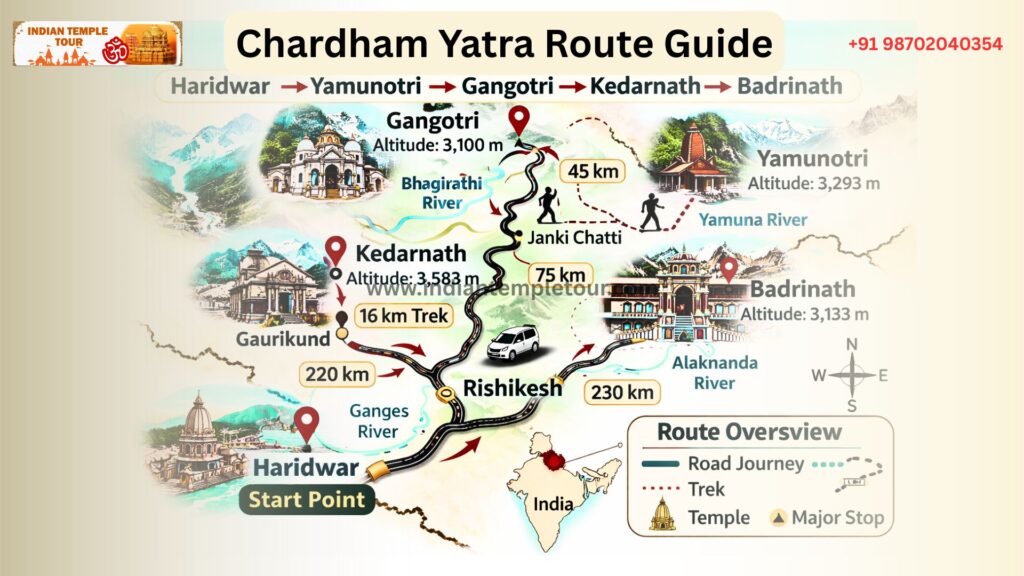
There are journeys you take for leisure, and then there are journeys that change you forever. The Chardham Yatra is the second kind — a sacred circuit through four Himalayan shrines believed to cleanse all sins and open the door to moksha.
Whether you are a first-time pilgrim or a lifelong devotee, this Chardham Route Guide covers every stop, every decision, and everything your Chardham package should include.
What is the Chardham Yatra?
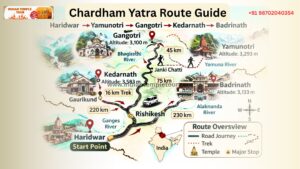
The word comes from Sanskrit — “Char” (four) and “Dham” (holy abode). These four shrines sit deep in the Garhwal Himalayas of Uttarakhand, established by the philosopher-saint Adi Shankaracharya in the 8th century to unite India spiritually. The journey follows a clockwise direction, starting and ending at Haridwar, and covers roughly 1,290 to 1,600 km by road.
| Dham | Deity | River origin | Altitude | Access |
| 1 Yamunotri | Goddess Yamuna | River Yamuna | 3,293 m | 5 km trek from Janki Chatti |
| 2 Gangotri | Goddess Ganga | River Ganga | 3,048 m | Motorable road |
| 3 Kedarnath | Lord Shiva (Jyotirlinga) | Mandakini River | 3,583 m | 18 km trek / helicopter |
| 4 Badrinath | Lord Vishnu (Badrinarayan) | Alaknanda River | 3,133 m | Motorable road |
The route — stop by stop
Starting point — Haridwar and Rishikesh
Your Chardham Yatra begins at Haridwar, the Gateway to the Gods, roughly 220 km from Delhi by road. Arrive a day early, attend the evening Ganga Aarti at Har Ki Pauri, and complete your mandatory Yatra biometric registration before the journey begins. Rishikesh is an equally valid starting point for pilgrims flying into Jolly Grant Airport, Dehradun.
First dham — Yamunotri
Yamunotri is the birthplace of the River Yamuna and the daughter of the Sun God. The temple has no road connection — pilgrims drive to Janki Chatti from Barkot and then trek 5 km uphill. Inside the temple precinct, the famous Surya Kund hot spring lets pilgrims cook rice and potatoes as prasad. After a cold mountain trek, dipping your feet in that warm spring is a moment pilgrims never forget.
Second dham — Gangotri
Gangotri marks the earthly origin of the River Ganga, where King Bhagirath’s prayers brought the celestial river down from heaven. Unlike Yamunotri, the temple is road-accessible, and the drive from Uttarkashi through the Bhagirathi gorge is one of the most scenic stretches of the entire Yatra. The adventurous can trek an additional 18 km to Gomukh Glacier — the actual snout of the Gangotri Glacier and the true source of the Ganga.
Third dham — Kedarnath
Kedarnath is the most challenging and most visited of the four dhams. The 18 km trek from Gaurikund climbs through dense forest and open mountain terrain. The temple itself is over 1,000 years old — built by the Pandavas and restored by Adi Shankaracharya — and survived the catastrophic 2013 floods largely intact, an event many consider a miracle. Attending the evening aarti inside this ancient stone shrine, with the Kedarnath peak glowing behind it at golden hour, is widely described as the spiritual peak of the entire journey.
Fourth dham — Badrinath
Badrinath is the perfect finale: no trek required, road-accessible, and deeply serene. The temple sits on the banks of the Alaknanda River between the Nar and Narayan mountain ranges. Before darshan, pilgrims bathe in the Tapt Kund hot spring just outside the gates. It is believed that meditating at Badrinath leads directly to moksha. The temple closes on Vijay Dashami (Dussehra), after which the deity is ceremonially shifted to Joshimath for winter.
Full route at a glance – Complete road route:
Haridwar → Dehradun → Barkot → Yamunotri → Uttarkashi → Gangotri → Guptkashi → Kedarnath → Joshimath → Badrinath → Rishikesh → Haridwar
| Day | Route | Distance | Key activity | Night stay |
| 1 | Arrive Haridwar | — | Ganga Aarti, registration | Haridwar |
| 2 | Haridwar → Barkot | 175 km | Scenic drive via Mussoorie | Barkot |
| 3 | Barkot → Yamunotri → Barkot | +5 km trek | Surya Kund, temple darshan | Barkot |
| 4 | Barkot → Uttarkashi | 100 km | Drive along Bhagirathi River | Uttarkashi |
| 5 | Uttarkashi → Gangotri → Uttarkashi | 105 km each way | Temple darshan, Gomukh option | Uttarkashi |
| 6 | Uttarkashi → Guptkashi | 200 km | Long drive, ~7–8 hours | Guptkashi |
| 7 | Guptkashi → Kedarnath | +18 km trek | Jyotirlinga darshan, evening aarti | Kedarnath |
| 8 | Kedarnath → Guptkashi | Return trek | Descend, rest day | Guptkashi |
| 9 | Guptkashi → Joshimath | ~150 km | Drive via Pipalkoti | Joshimath |
| 10 | Joshimath → Badrinath | 45 km | Tapt Kund bath, final darshan | Badrinath |
| 11 | Badrinath → Haridwar | ~300 km | Return journey, yatra complete | Home |
Best time to visit
The temples open in late April or early May and close in October–November. The season has three distinct windows — each suitable for a different type of traveler.
| Window | Months | Weather | Crowd level | Best for |
| Peak season | May – June | Pleasant, mild | Very high | First-timers — book your Chardham Yatra package early |
| Avoid | July – August | Monsoon, landslides | Low | Experienced hill travelers only |
| Best value | Sep – Oct | Clear skies, cool | Moderate | Those who prefer a quiet, unhurried pilgrimage |
2026 opening dates:
- Yamunotri & Gangotri — April 19
- Kedarnath — April 22
- Badrinath — April 23.
Closing: Probably on November
How to choose the right Chardham Yatra package
Traveling independently is possible but challenging — high altitudes, mountain roads, limited accommodation, and mandatory registration make a well-organized Chardham Yatra package the smarter choice for most families, senior pilgrims, and first-timers. Here is what every good package must include:
Transportation
Toyota Innova or equivalent with an experienced hill driver. Confirm return journey is included.
Accommodation
Stays at Barkot, Uttarkashi, Guptkashi, Joshimath, and Badrinath. GMVN guesthouses from ₹1,000/night are reliable and affordable.
Meals
Breakfast and dinner included at each base. Simple Garhwali cuisine — nutritious, locally sourced, and filling.
Registration support
Yatra biometric registration is mandatory since 2023. A good operator handles passes as part of the package.
Medical support
Oxygen cylinders and emergency contacts for high-altitude sections, especially Kedarnath at 3,583 m.
Helicopter option
For elderly or less mobile pilgrims. Book Kedarnath heli in advance — it sells out fast every season.
Customization
Solo traveler, family, or senior group — the package should flex to your pace and needs.
Travel insurance
Non-negotiable for high-altitude travel, especially for pre-existing health conditions.
Important tips before you go
Register early
Biometric Yatra pass from the Uttarakhand government portal. Carry it throughout the journey.
Pack smart
Woolens, rain gear, sturdy shoes, first aid kit, ORS sachets, personal medicines, energy snacks.
Stay hydrated
Altitude sickness is real. Drinking plenty of water at every stop is the simplest prevention.
Respect temple rules
No leather inside temple premises. No reels or video inside Kedarnath — it is now a mobile-free zone.
Medical clearance
Children under 12 and adults over 65 need additional clearances before trekking to Kedarnath.
Watch for fraud
Book helicopter and accommodation only through verified, government-listed operators.
The Chardham Yatra is not a journey across four temples. It is a journey within — each dham strips away a little more of the ordinary. From the roaring Bhagirathi at Gangotri to the ancient stone silence of Kedarnath, every step carries centuries of devotion. When you finally stand at Badrinath watching the Alaknanda flow beneath snow peaks at dusk, you will understand why pilgrims have walked this path for over a thousand years. Start planning your Chardham Yatra package today — travel wisely, travel safely, and let the mountains guide you home.
About Author